

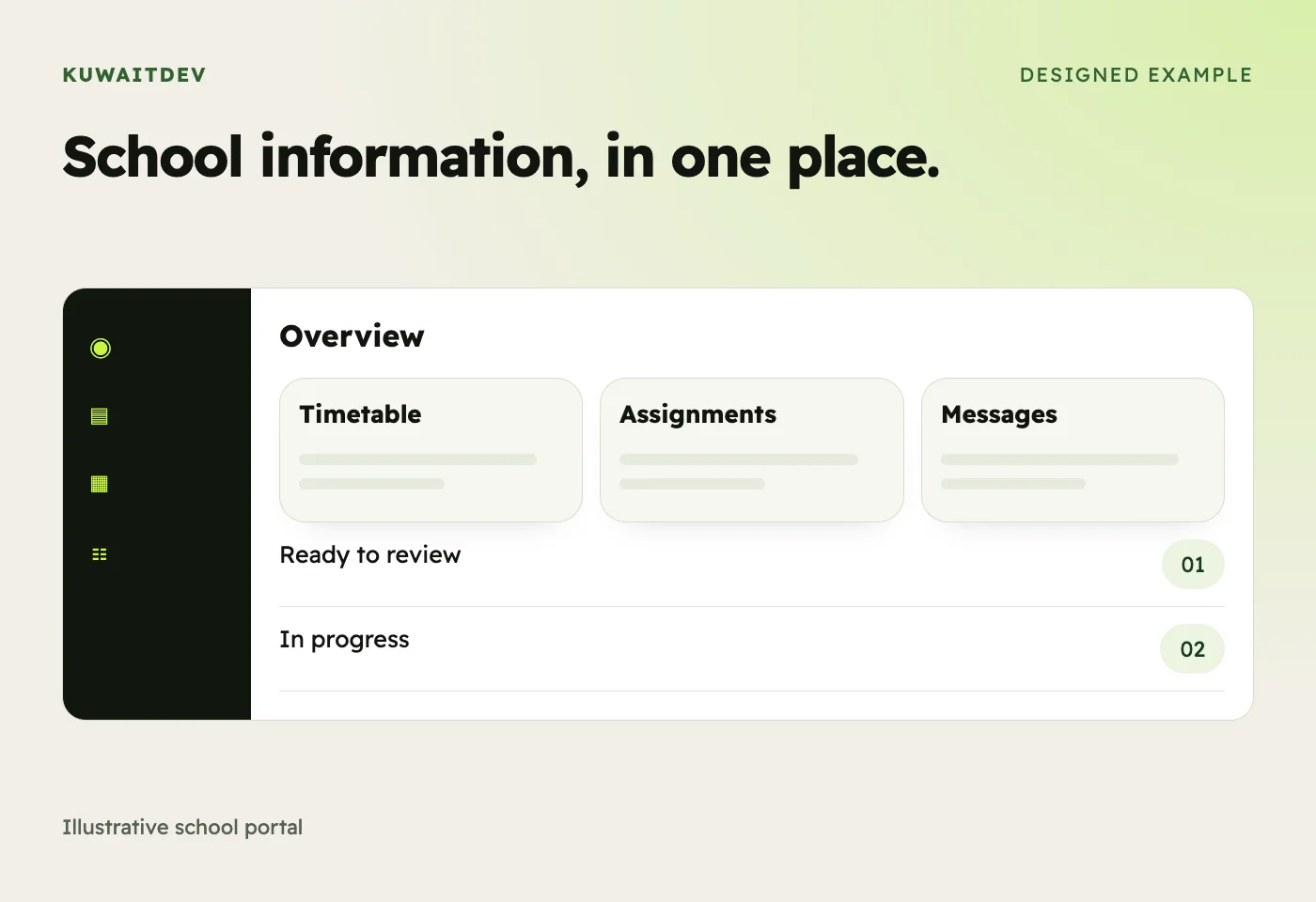
The challenge
Most school websites in Kuwait are digital brochures. A parent visits once during admissions and never returns, so the school keeps running on WhatsApp groups, paper circulars and cheques at the accounts window. Give parents grades, attendance, schedules, fees and announcements in one place and the site becomes the daily link between home and school instead of a page nobody opens.
School websites parents actually use are the ones that give them a reason to log in on a Tuesday. In Kuwait that reason is usually the same short list: my child’s marks, was she in school today, what is due this week, and how do I pay the next instalment without driving to the accounts office. Build those four things properly and the rest of the site takes care of itself.
How schools in Kuwait win and keep families
Private schools here compete in two seasons. Admissions decide the year’s intake, and daily communication decides whether the family stays and recommends you. Parents compare schools by curriculum, fees, transport routes and how organised the school feels, and a website that cannot answer a fee question or accept an application online tells them something about the administration.
The same applies once the child is enrolled. Schools that run entirely on WhatsApp groups end up with teachers answering personal messages at night, circulars that half the parents never see, and an accounts office buried in cheques every term. A portal does not replace the relationship, it removes the repetitive part of it.
The features that matter, and why
A parent portal with real daily content. Marks, attendance, timetable, homework and reports for each child, with one login for a parent who has three children in different years. Without daily content a portal is abandoned in a month.
Online fee payment by KNET. KNET is how most people in Kuwait pay, and letting parents pay instalments, bus and trip fees from a phone removes queues at the window and shortens collection time. Every payment produces a numbered receipt in both languages, and finance gets a reconciled report. We handle the gateway and KNET integration as part of the same project.
Admissions that finish online. The form, the birth certificate and passport uploads, the fee schedule, and a status the parent can check without calling the office. Half-finished applications stay in the system so admissions can follow them up.
Genuinely bilingual content. Arabic and English, right to left where it should be, including letters, announcements, receipts and the forms themselves. In Kuwait a school serves Arabic-speaking and English-speaking families in the same building, and a translated-looking site loses trust with both. Our bilingual website service and the bilingual website guide cover how this is done properly.
Announcements that reach people. A single post going to the portal, email and a message, so no parent can say they never heard about the trip. Same-morning absence alerts are the version parents value most.
Roles and permissions. Teachers, heads of year, admissions, finance and administration each see a different part. This is what makes a school comfortable putting real student data online.
What a typical project looks like
- Free first hour with an engineer. Curriculum, number of students, what management system you run, fee structure and who will maintain the site.
- Structure and content plan. Sitemap, Arabic and English text, photography, and the list of documents parents ask for every year.
- Design. Public site and portal, designed for a phone first, because that is where parents will check marks.
- Build. Portal, admissions, announcements, calendar, staff area, admin panel.
- Payments and integration. KNET and card, fee items and instalments, then the link to your management system with a full test on real data for one class.
- Training and launch. Office staff and teachers trained separately, then a soft launch to one year group before the whole school.
What it costs
At 10 KWD per hour, a school project runs 35 to 115 hours.
| What you are building | Hours | Cost |
|---|---|---|
| Public site with admissions forms and announcements | 35 to 55 | 350 to 550 KWD |
| Plus parent portal with grades and attendance | 55 to 80 | 550 to 800 KWD |
| Full system with fee payment, transport, integration | 80 to 115 | 800 to 1,150 KWD |
Price your own list in the cost calculator, or read the rate and longer-term discounts on the pricing page. Schools that need more than a website, such as a custom timetable or transport system, start from our web development practice and the free first hour.