

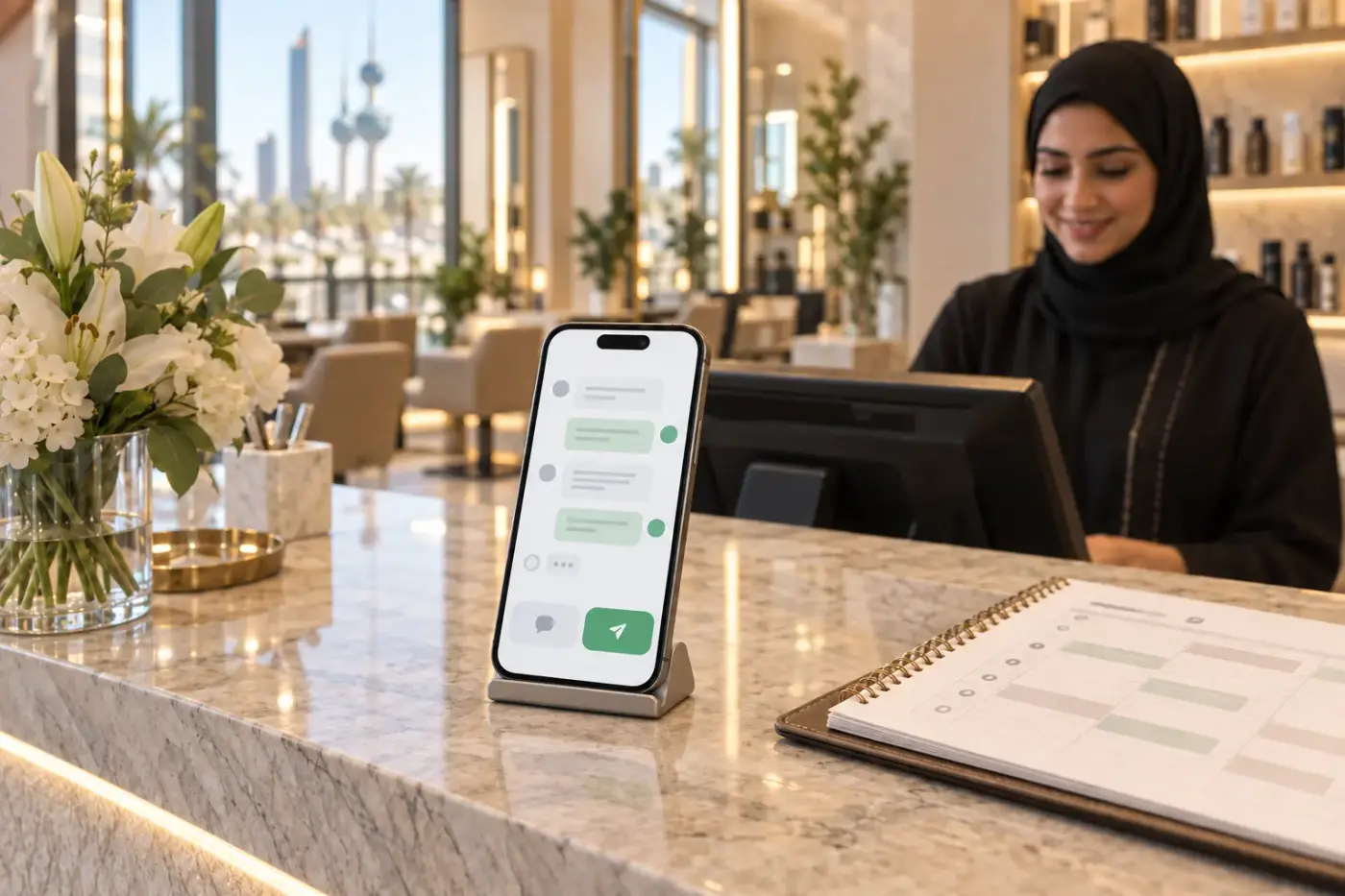
Your customers message you on WhatsApp at eleven at night and expect an answer. Someone on your team replies from a phone at home, and by morning four messages have been missed. An AI chatbot answers those messages the moment they arrive, in Arabic or English, and books the appointment or confirms the order while the customer still cares. It costs between 170 and 550 KWD to build and runs on your own prices and policies, not on generic answers.
What a chatbot does, and what it does not
A chatbot holds a conversation. It answers questions, checks an order, books an appointment, takes a name and a number, and passes the customer to a person when the question gets beyond it. Everything happens inside one thread with one customer.
An AI agent does the work behind the conversation. It reads the new order, creates it in your system, sends the payment link, tells the driver and updates the sheet, usually with nobody chatting to it at all. The two fit together, and the chatbot is almost always the right first step because customers see it on day one and because it shows you exactly which requests repeat.
A chatbot will not negotiate a price, approve a refund, calm down an angry customer or make a promise you have not written down. It should not try. The businesses that get value from one are the businesses that decided in advance where the bot stops.
What you get
The bot answers on WhatsApp Business, on Instagram direct messages and in the chat window on your website, with one set of answers behind all three. It replies in the language the customer wrote in, and it switches mid conversation if they do.
Its answers come from your material only: your price list, your branch hours, your delivery areas, your return policy. If the answer is not in there, it does not invent one. It can also read live data, so a customer asking “where is my order” gets the real status rather than a promise that someone will check.
Booking is where most Kuwait businesses see the value first. A clinic, a salon or a restaurant can let the customer pick a time inside the chat and get a reminder the day before, without anyone touching the calendar. Every conversation the bot could not finish lands with a named person, with the history attached.
How we build it
- We read your last few hundred customer messages and group them. This is the most useful hour of the project, because the real questions are never the ones on the FAQ page.
- We write the answer set with you, in both languages, and agree the line where the bot stops and a person takes over.
- We connect the channels. If you are still on the free WhatsApp Business app, we move you to the official API first, which needs Meta verification and a few working days.
- We connect the systems the bot needs to read, such as your booking calendar or your order records.
- We test it against your own past conversations, in dialect and in English, and fix what it gets wrong before a customer sees it.
- We go live on one channel, watch it for a week, then open the rest.
Cost and timeline
Work is billed at 10 KWD per hour, published on our pricing page. For a rough budget before you talk to us, the cost calculator covers the usual shapes of project.
| Part of the work | Hours | Cost at 10 KWD/hour |
|---|---|---|
| Reading your real messages and writing the answer set | 4 to 8 | 40 to 80 KWD |
| Connecting WhatsApp, Instagram and website chat | 3 to 8 | 30 to 80 KWD |
| Loading your prices, hours, branches and policies | 4 to 14 | 40 to 140 KWD |
| Booking or order lookup inside the chat | 3 to 14 | 30 to 140 KWD |
| Handover rules, bilingual testing, launch | 3 to 11 | 30 to 110 KWD |
| Total | 17 to 55 | 170 to 550 KWD |
Two to four weeks from start to live. The monthly running cost is small and depends on how many messages you get. You pay it directly to the providers, so you can see it.
Pitfalls worth avoiding
Do not launch a bot that cannot hand over. A customer stuck in a loop with a machine at midnight is worse than an unanswered message.
Do not let it quote prices it cannot verify. If your pricing depends on the case, the bot should collect the details and pass them on, not guess.
Do not treat Arabic as a translation of the English answers. Customers write in dialect, they ask in a different order, and the answer that works in English often reads as cold in Arabic. We write both.
Do not buy a bot for a problem that is really a process problem. If enquiries are lost because three people share one phone, fixing the phone comes first. That is the kind of thing we will tell you in the free consultation before you spend anything. For the wider picture of what AI can and cannot do for a Kuwait business, see our AI solutions practice.