

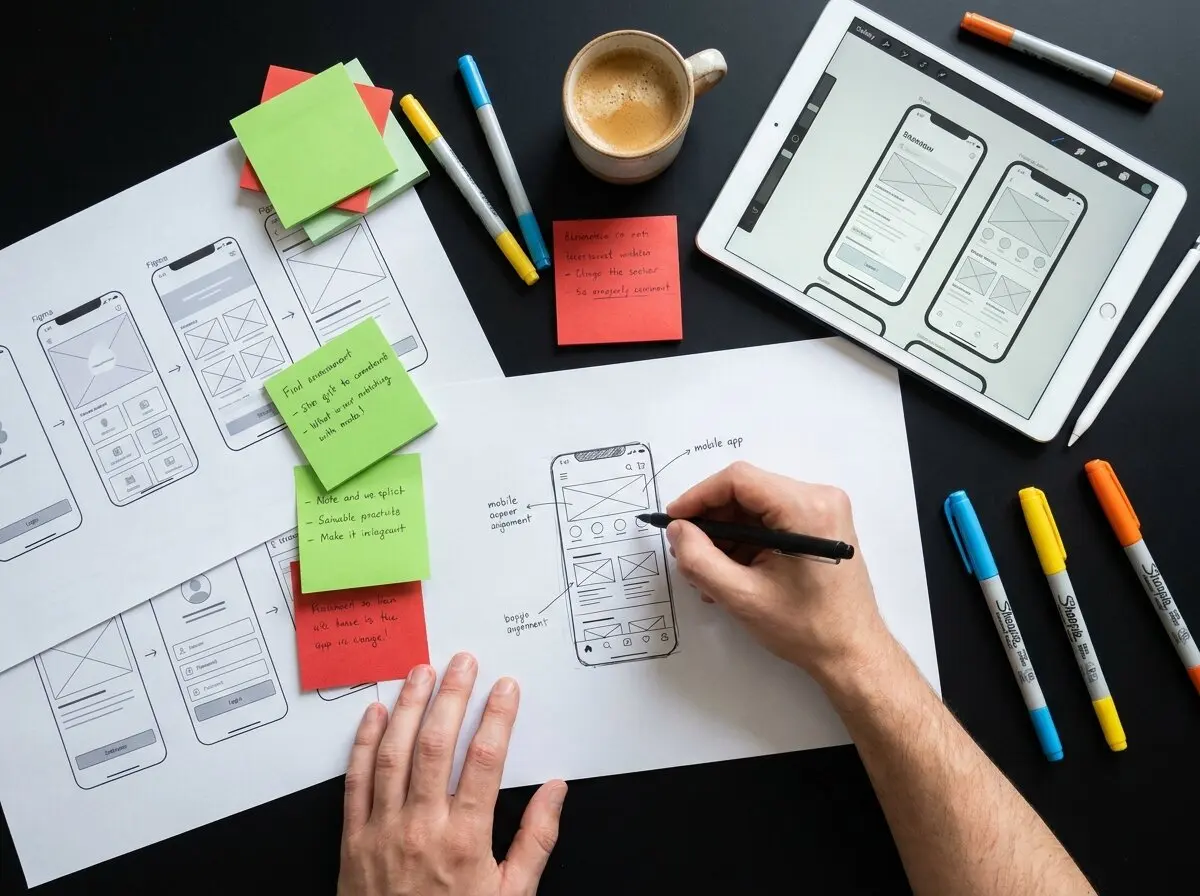
Design that converts is design that gets out of the way. Most Kuwait sites that fail do not fail because they look bad. They fail because the phone number is buried, the price appears after four taps, the Arabic page reads like it was flipped, and the checkout asks for information nobody has to hand. Design work costs between 170 and 550 KWD and it is the cheapest point in the project to fix any of that.
What the problem usually is
You have visitors. Your Instagram sends people to the site. They arrive, and then nothing happens.
What we find, over and over: the thing the customer came for is two or three taps further down than they will bother going. The site was designed on a wide screen while almost every visitor is on a phone, often outdoors in bright light on a slow connection. The Arabic version is the English one reversed, so an Arabic reader meets a layout that feels borrowed. And the form asks for a civil ID number or a building number in the first field, at the exact moment the customer is deciding whether to continue.
None of those are taste problems. They are decisions that were never made, and they are cheap to make on paper.
What you get
Screens for the pages that carry your business, drawn in Arabic and English as two real layouts. You click through them on your own phone before anyone writes a line of code, which is when most owners discover a step they never wanted.
You get the flows counted: how many taps from the first screen to a confirmed booking, how many fields between the basket and a paid order. You get text sizes people can read, contrast that survives daylight, and tap targets a thumb can hit. You get a component set, so a button, a card and a form field are defined once and reused, which keeps the build faster and the site consistent as it grows.
And you get the files in a state a developer can build from, with the behaviour written down: what happens on error, what an empty screen says, how the layout changes in Arabic.
How we work
- We agree the one thing each key screen exists to make happen. A page trying to do four things does none.
- We look at what you have. If there is an existing site, we watch a few real people use it, which is usually faster than any analysis.
- We map the flows as plain steps, then cut the steps that only exist because an old process demanded them.
- We draw the screens grey and unstyled first, in both directions, so the conversation stays on the structure rather than the colour.
- We apply your brand, and design the Arabic and English versions alongside each other, never one after the other.
- We put the clickable version in front of a handful of real users in Kuwait, fix what trips them, then hand over the files and the component set to whoever builds it.
Cost and timeline
Design is billed at 10 KWD per hour like everything else. See the pricing page, or the cost calculator if you want a number before you call.
| Part of the work | Hours | Cost at 10 KWD/hour |
|---|---|---|
| Understanding your customers and what they came for | 3 to 8 | 30 to 80 KWD |
| Structure and grey screens for the key pages | 4 to 12 | 40 to 120 KWD |
| Visual design, Arabic and English | 5 to 18 | 50 to 180 KWD |
| Component set and rules | 3 to 10 | 30 to 100 KWD |
| Testing with real users and handover | 2 to 7 | 20 to 70 KWD |
| Total | 17 to 55 | 170 to 550 KWD |
One to six weeks depending on the size. On a full build these hours sit inside the project rather than beside it, and they overlap with the start of development.
Pitfalls
Designing for the boss instead of the customer is the common one. The person paying is rarely the person who will use the screen at eleven at night with one hand.
Skipping the grey screens is the expensive one. If the first thing anyone sees is a polished picture, the conversation becomes about colour, and the structural mistake stays in.
Treating Arabic as a setting rather than a design is the one Kuwaiti customers notice. It belongs in the same conversation as the English layout, which is why we handle it inside bilingual development rather than as an afterthought.
And design that is never built is wasted money. Beautiful files with no note on behaviour get interpreted by whoever writes the code. We hand over to our own web and mobile teams, or to yours, with the rules attached.